

Parallax: entertainment website design for a shared-reality venue brand
A concept immersive-venue brand. We designed its identity, design system, motion and a multi-page website with event discovery, ticketing and private-event booking.
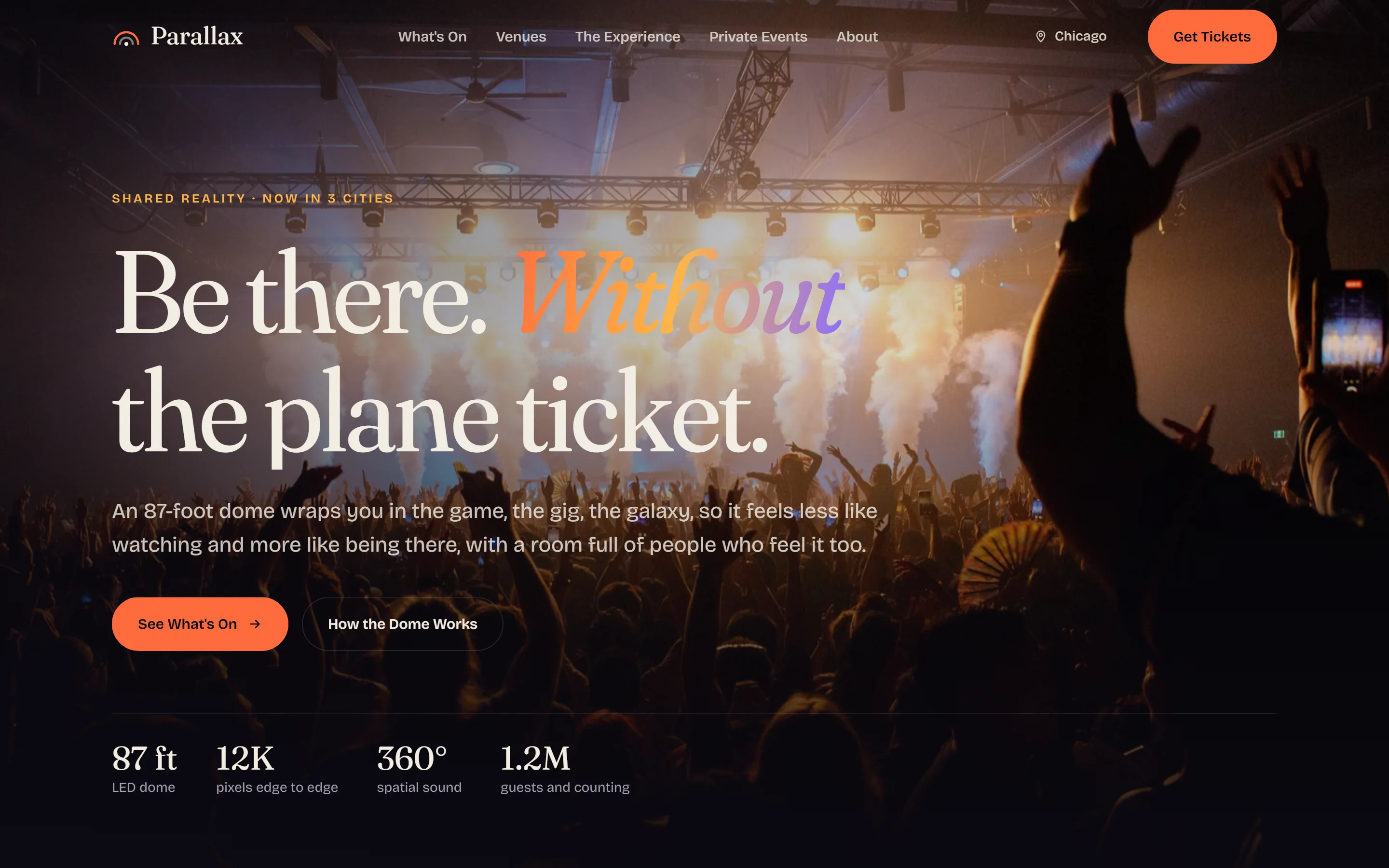
Parallax is a concept shared reality venue brand built around an 87-foot immersive dome venue and LED dome experience, where live sports, concert film experiences, immersive cinema and immersive art and light experiences wrap around a room full of people. As an experiential design agency and immersive experience design agency, we made it to show how we do entertainment website design and entertainment web design: an immersive venue website that feels as cinematic as the dome and still sells tickets in a few taps. We treated the website as the first room of the venue.
Project facts
- Type — self-initiated concept. Parallax, its venues, events, prices and venue figures are fictional sample content.
- Sector — location-based entertainment, sports and live events
- Services — entertainment brand strategy, brand identity, web design, venue UI/UX design, design system, motion design, front-end build
- Deliverables — a multi-page responsive website, a reusable component library, a motion system, a locale-ready architecture
- Platforms — desktop, tablet and mobile web
The challenge: selling a feeling you can’t see on a screen
Shared-reality venues have an unusual marketing problem. The product is a physical sensation: a dome that fills your peripheral vision, sound that moves around you, a crowd reacting together. A flat screen can’t deliver that. Most venue websites fall back on generic ticketing layouts that strip out the magic, or they lean so hard into spectacle that booking becomes a chore.
Parallax needed one digital home that could:
- Make a shared reality platform feel tangible to people who have never been inside a dome
- Serve four audiences at once: sports fans, concert-goers, families and corporate event planners
- Turn browsing into bookings across events, venues and private hire
- Scale to new cities and international locales without a redesign
That is where location based entertainment design differs from standard web work, and where an experiential agency or experiential marketing agency brief meets a digital build. The site has to hold atmosphere and utility in the same frame.
Our approach as an experiential design agency: audit first, then a system
As an immersive design agency and digital experiential agency, we started with a full audit of category leaders in immersive venues and mapped every page type they used. What looked like 90+ unique pages came down to 8 core page templates and 7 reusable content blocks. That insight shaped everything: fewer, better templates give visitors a more consistent experience and make new venues quicker to launch.
- Audit and architecture. Content inventory, template mapping and user journeys for each audience.
- Entertainment brand strategy. Positioning around one idea: “Be there. Without the plane ticket.”
- Visual identity and design system. Type, color, motion and components built for dark, cinematic environments.
- Prototype and build. A static front end with motion built in from day one.
Brand identity: immersive branding for a night out, not a software product
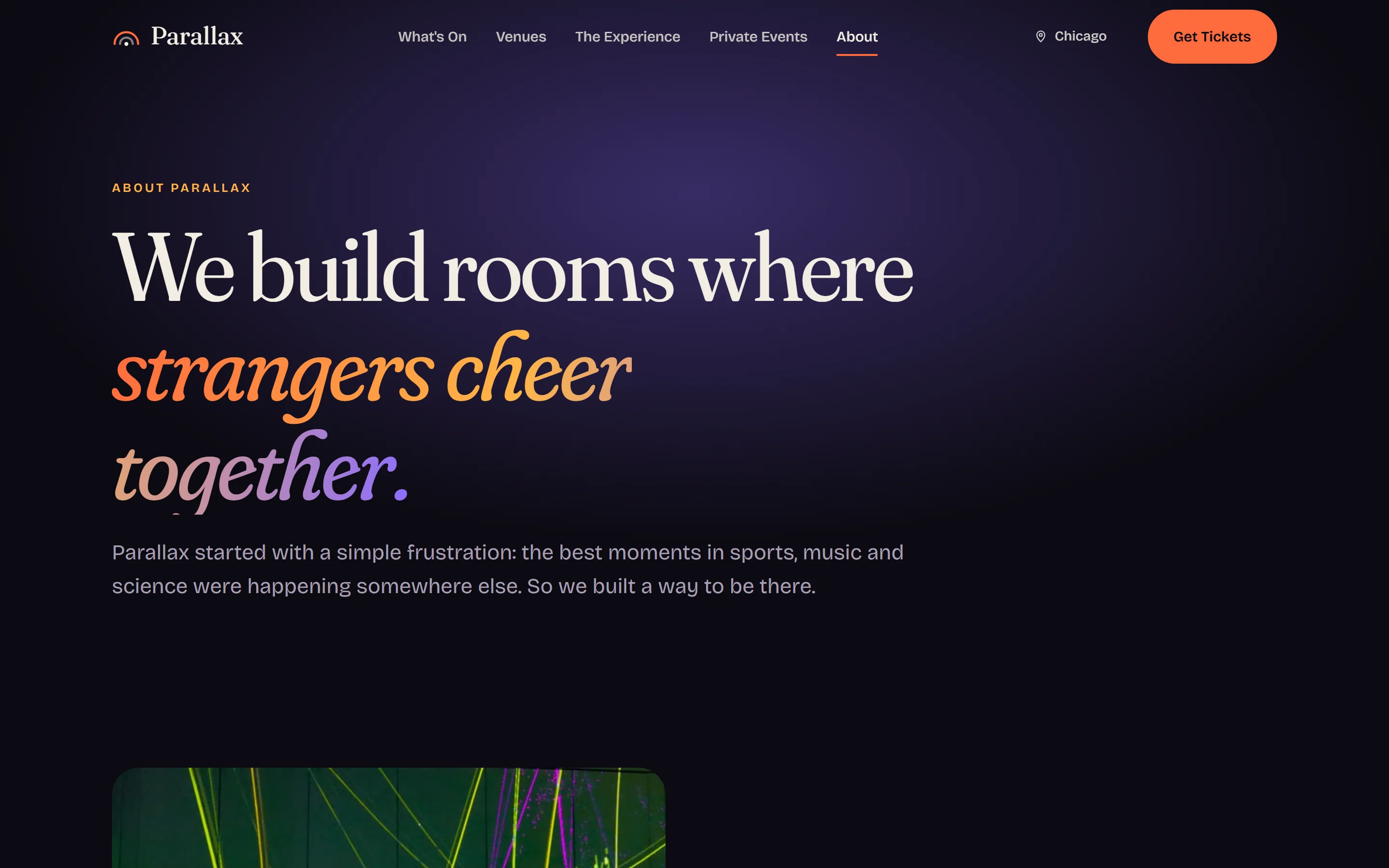
As a brand experience agency and immersive branding agency, we wanted the identity to feel like the moment the house lights go down.
- Typography. An expressive, soft-edged display serif with dramatic italics for headlines, paired with a characterful grotesque for body copy. It reads like a film title sequence rather than a SaaS dashboard.
- Color. A dark mode palette with a deep after-dark ink base, warm cream text and an ember-to-amber accent gradient with a violet glow, inspired by the light that spills off an LED dome.
- Logo mark. Concentric arcs that suggest a dome, a horizon and a sound wave at once.
- Voice. Confident, warm and a little cheeky: “Come for the show. Stay for the short rib.”
The identity is meant to work on an 87-foot screen and a 6-inch phone alike: dark mode website design with a cinematic web design feel.
A custom design system for entertainment
One set of components produces every page on the site. See our design systems service.
- Reusable blocks — hero, event rail, category tiles, split feature, dome showcase, venue cards, story cards, CTA band, FAQ, gallery mosaic and forms
- Design tokens — color, type and spacing live in a single theme file, so a new market can be re-skinned without touching the templates
- Locale-ready content layer — navigation, venues, footer and legal copy are driven by one configuration file per locale, ready for UK, EU or APAC rollouts with tailored content and design changes
Homepage: atmosphere first, tickets one tap away
As an immersive cinema website, the homepage opens on a full-bleed hero with a slow cinematic push-in, then hands visitors straight to what’s on this week.
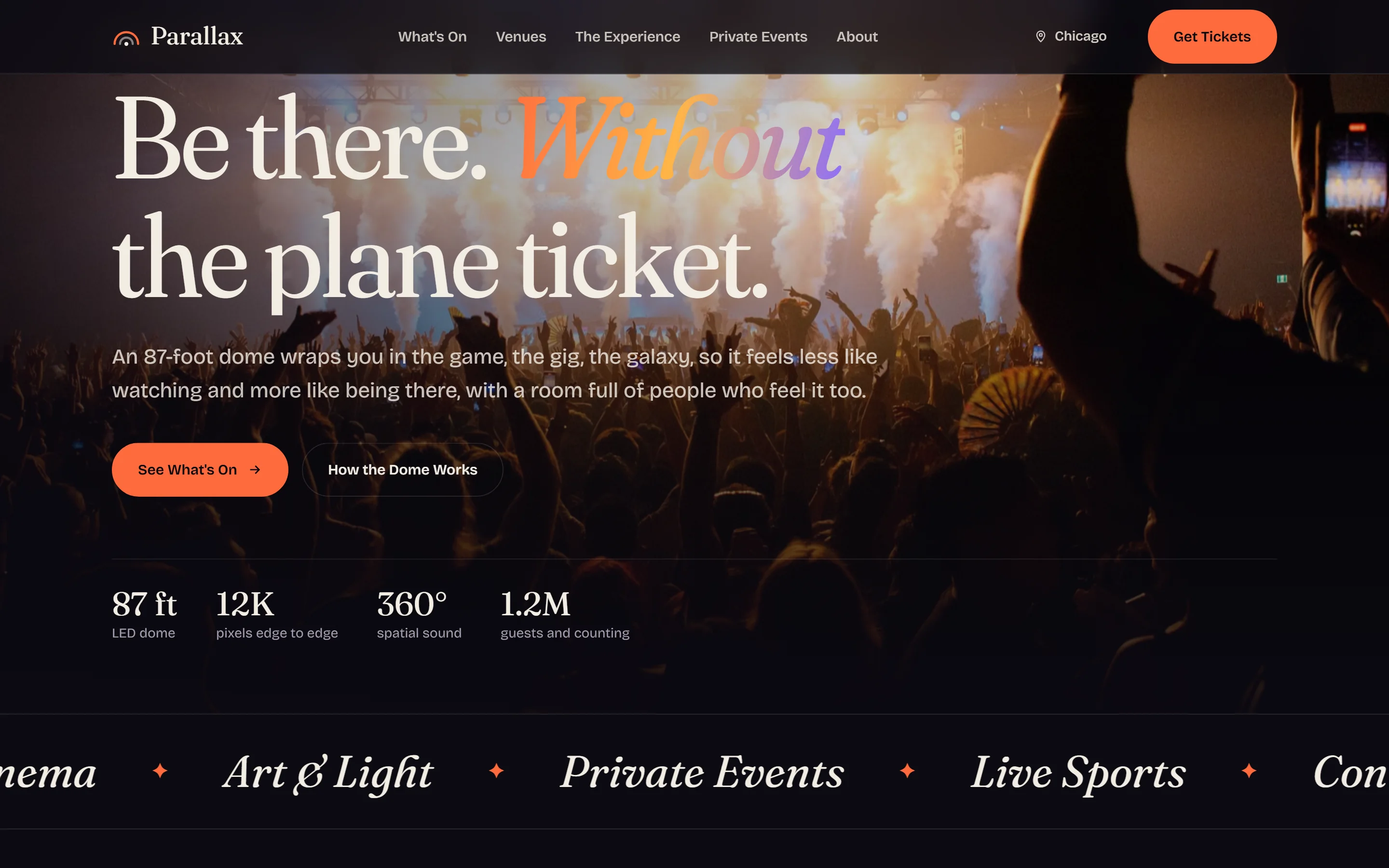
- Hero with venue stats. Dome size, resolution, spatial audio, the 360° immersive experience and guest numbers build credibility in seconds.
- Kinetic marquee. A continuously scrolling strip of program categories sets the rhythm.
- “This week under the dome” rail. A drag-to-scroll event carousel with date badges and pricing.
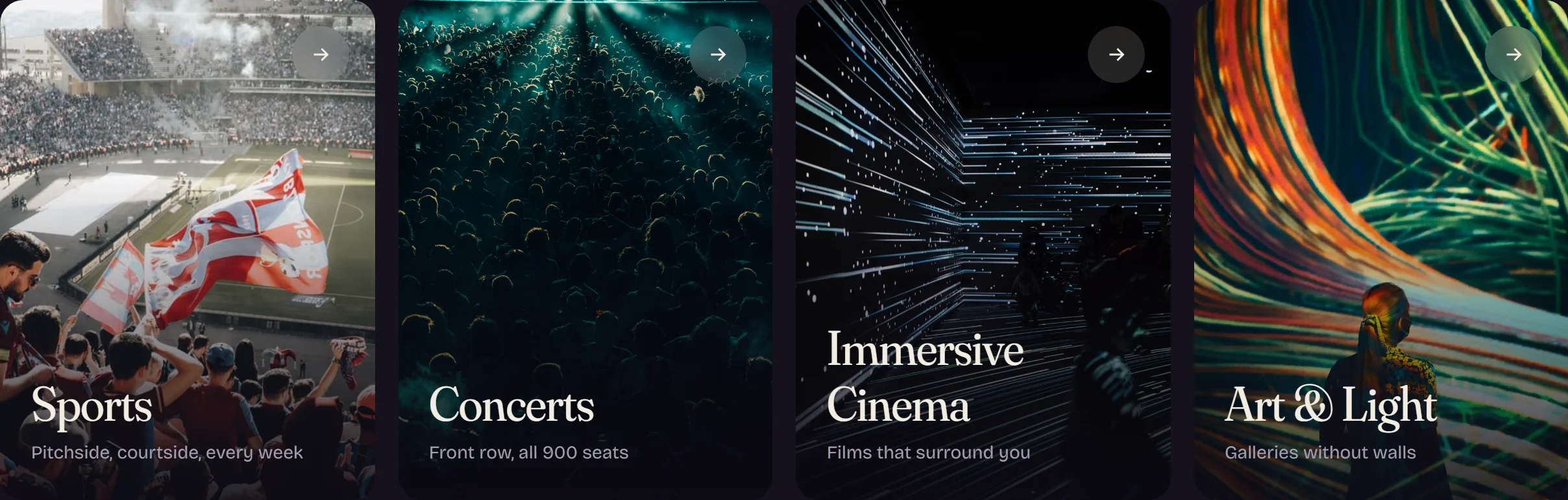
- Category tiles. Live sports watch parties, concert film experiences, immersive cinema, and art and light shows, each with a hover zoom and a rotating arrow cue.
- Sports viewing feature. A split section that sells the dome as a live sports watch party venue, a piece of sports viewing experience design.
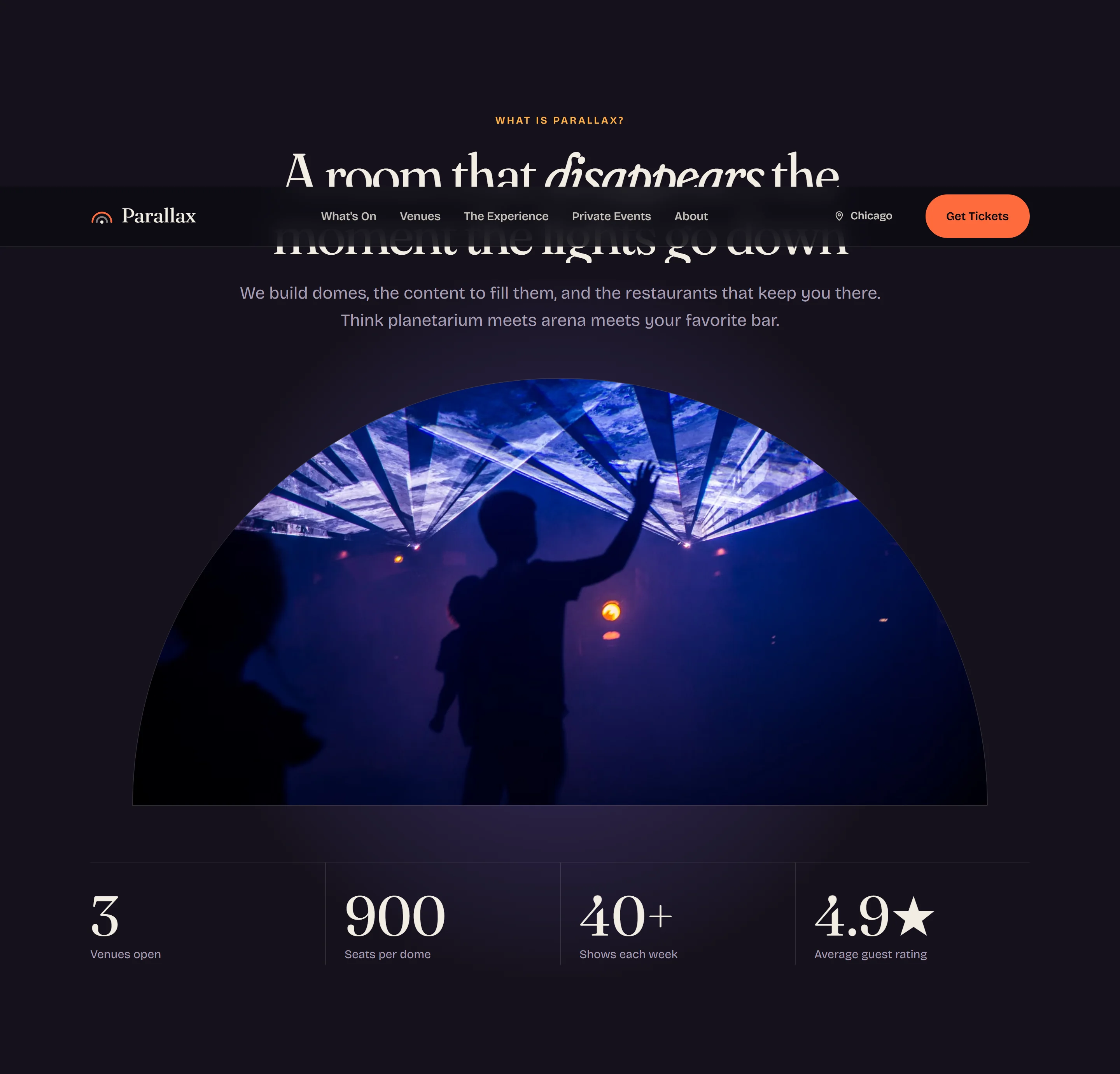
- Dome showcase. An arched image frame that mirrors the venue’s shape, followed by key numbers.
Venue pages: stadium digital experience design
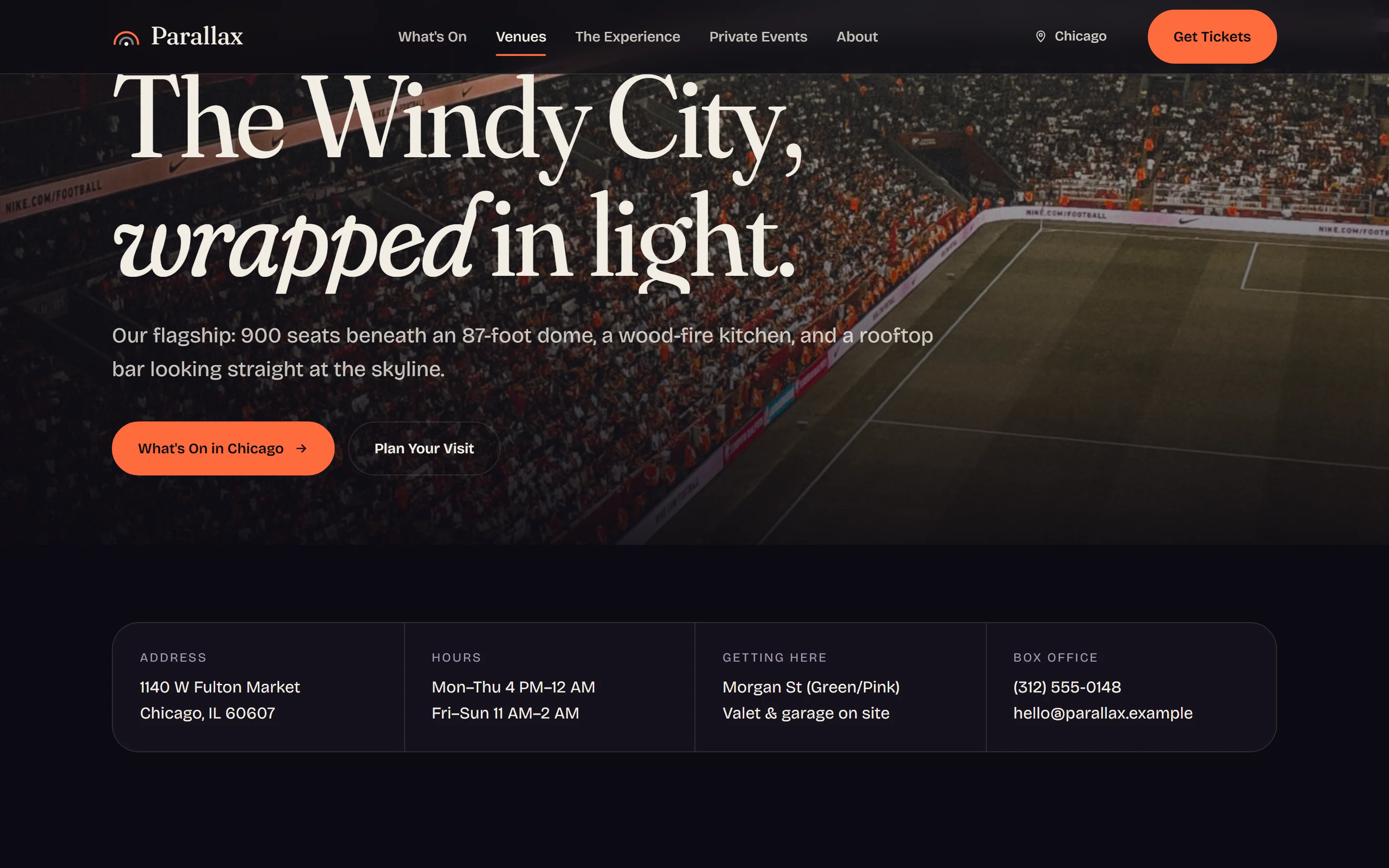
Each city gets its own venue hub, designed with venue UI UX design and stadium digital experience design thinking to answer “when, where, how do I get there” instantly, then sell the night.
- A four-part info bar covering address, hours, transit and box office
- A city-specific event rail
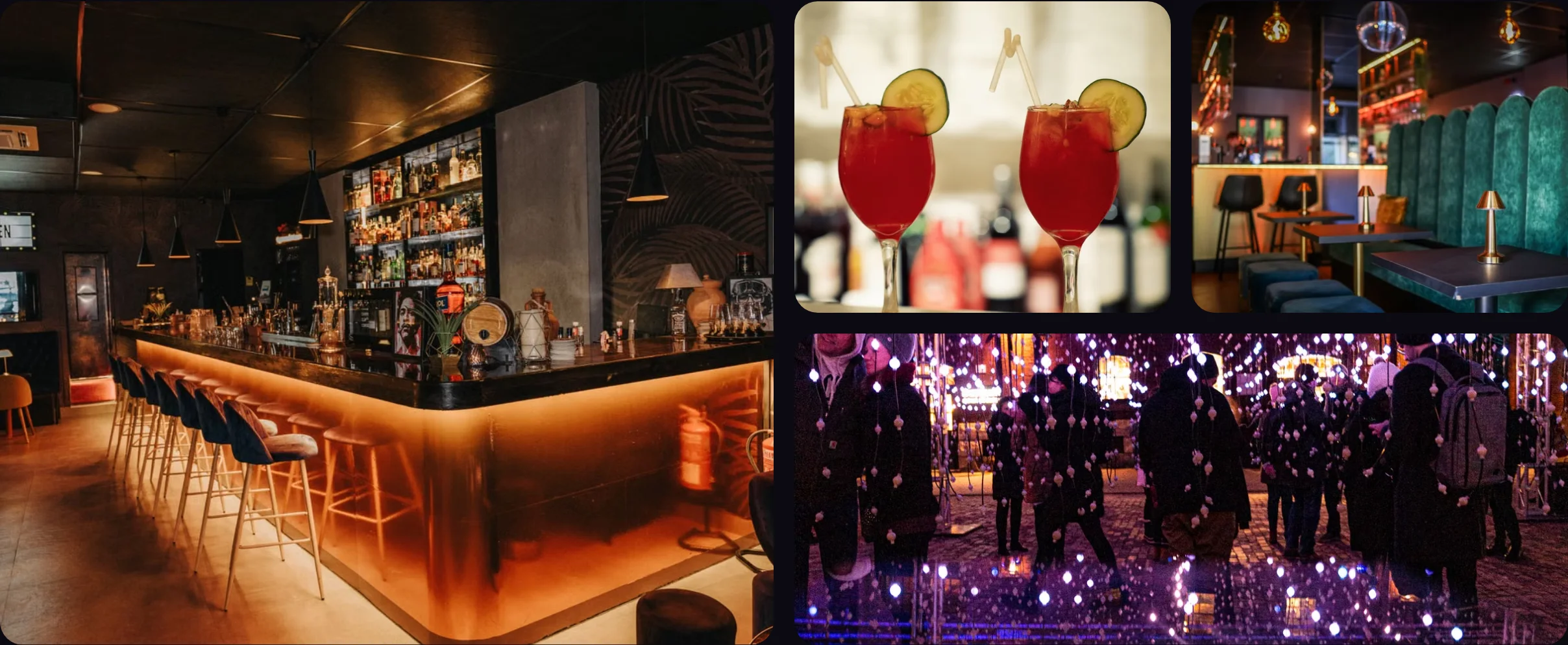
- A food and drink feature with a chef story and a rooftop bar badge
- A venue gallery mosaic and a dark-mode map
One template serves every city, which makes it multi-venue website design and event venue website design that keeps future launches quick and consistent. Dining is treated as part of the show, with restaurant and bar menu UX, in-seat ordering UX and an interactive menu UX tied to each show, positioning Parallax as a dining and entertainment venue, not just a screen.

Event discovery and booking: venue ticketing app design
Discovery and checkout are where venue ticketing app design and event ticket booking UX matter most.
- What’s On page. Instant category filtering with animated chips, no page reloads.
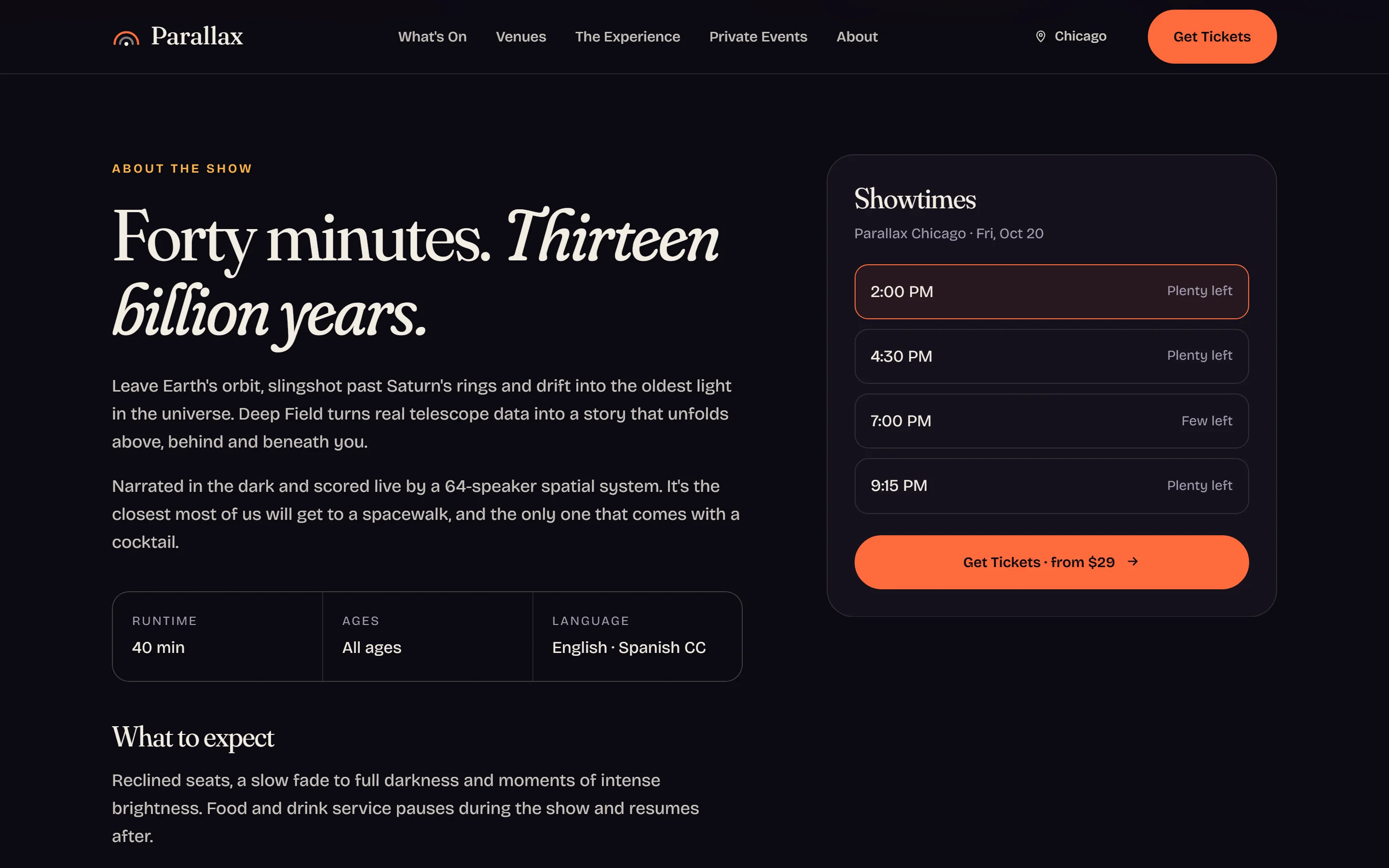
- Event detail page. A story-led synopsis, quick facts (runtime, ages, language) and a sticky showtime panel, so the booking action follows you down the page.
- Showtime selector design. Tap a time, see availability, book.
- FAQ accordion. Motion-sickness, arrival and accessibility questions are answered before they become support tickets.
Private events: venue website conversion optimization
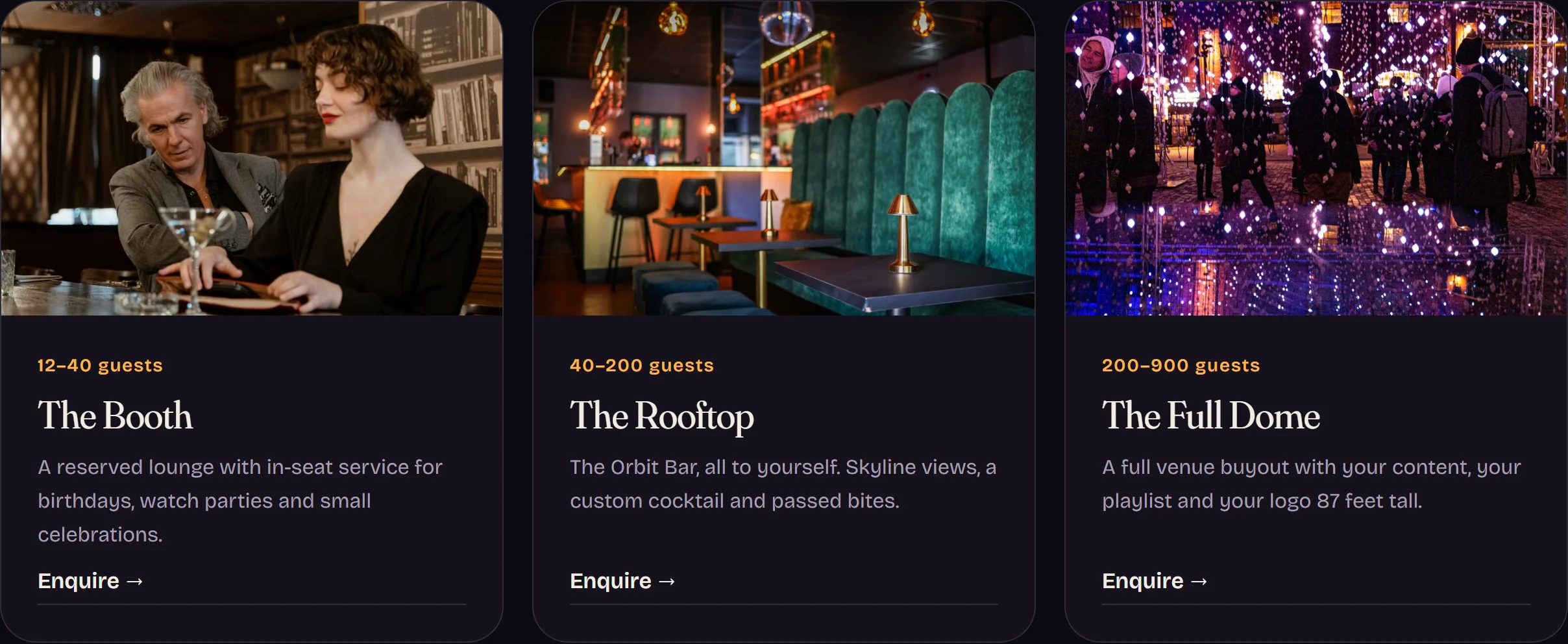
Group and private hire is a high-value revenue line, so this private event venue website page, with its group sales page design and corporate event booking UX, is built around venue website conversion optimization:
- A clear capacity ladder (12–40, 40–200 and 200–900 guests) in three package cards
- Proof points up front: events hosted, guest range, bookable spaces and proposal turnaround
- A brand-launch section aimed at corporate planners and experiential marketing agencies booking for clients
- A short enquiry form with inline confirmation, placed next to objection-handling FAQs
Motion and interaction design
Motion is how we brought the dome feeling onto a flat screen. Every section has a choreographed entrance, and every interactive element responds to the visitor. This is venue motion graphics design thinking applied to a scroll animation website. See our motion design work.
- Scroll reveals fade and rise every section into view with staggered timing.
- Image unmask reveals large images with a clip-path wipe and a subtle scale-down.
- Cinematic hero pushes in and drifts slowly, like a camera move.
- Kinetic marquee scrolls the category strip endlessly.
- Smart header starts transparent over the hero, then turns to frosted glass on scroll.
- Drag-to-scroll rails take mouse drag and arrow controls, with native swipe on touch.
- Card hovers ease images in, rotate arrows and shift colors.
- Showtime picker and accordions have clear highlight and open states.
- Mobile menu is a full-screen editorial menu with an animated burger.
All motion respects the reduced-motion preference.
Build: light, accessible and ready for every market
- Static build. Framework-free, with roughly 25 KB of combined CSS and JavaScript before compression.
- Images. Native lazy-loading below the fold, with a priority-loaded hero image.
- Responsive. Layouts from 320 px phones to ultra-wide displays.
- Accessibility. Semantic HTML, descriptive alt text and labeled form fields, an accessible venue website that matches the venue’s sensory-friendly sessions, step-free access and assistive listening content, in the spirit of sensory-friendly experience design.
- Locales. Design (theme tokens), shared content (a locale configuration file) and page content are separate. Launching a new locale means duplicating one folder and swapping two files, with no redesign and no rebuild.
What we delivered
- A template and content audit that reduced 90+ pages to 8 templates and 7 blocks
- A brand identity: type, color, logo mark and voice
- A custom design system and a locale-ready content architecture
- A responsive, multi-page website with a motion system
What’s next
The same design language extends into in-venue screens and interactive display design for lobbies, live sports streaming app design for companion apps and spatial computing UX for headset experiences. One brand system, every touchpoint, and a base for sports tech digital marketing rolling out city by city.
Planning a venue, attraction or live experience?
We design entertainment websites, brand experiences and digital products that make people want to be there. If you need an immersive experience design agency or experiential design agency partner, see our web design and branding services, or more work in the media and entertainment industry.
FAQ
Is Parallax a real venue?
No. Parallax is a self-initiated concept we created for this project. The venues, events, prices and venue figures are sample content.
What does an experiential design agency do?
An experiential design agency creates brand experiences people feel as well as see, across physical venues, websites, apps and events. For Parallax we connected the in-venue dome experience with the digital journey.
What makes good entertainment website design?
Strong atmosphere, fast discovery and frictionless booking. Great entertainment web design sells the feeling of being there, then gets out of the way at checkout.
How do you design UX for a venue website?
We map every visitor type (fans, families, groups, corporate planners), then design templates around their key questions: what's on, where is it, how do I book. Venue UI/UX design should answer all three above the fold.
Can one website design work across multiple cities and countries?
Yes. With a custom design system and a locale-ready content layer, new venues and markets reuse the same templates with tailored content and theme tweaks.
Do you work with experiential marketing agencies?
We're happy to work with experiential marketing and brand experience agencies on the digital design and build side.